
5 minute read | November 9, 2026
Aligning Technical Mastery with Strategic Leadership: How 10% Dedicated Growth Time Drives Engineering Leadership at VIOOH
Written By: Georgios Karametas
Co-created directly with VIOOHers, our learning framework—Your Growth—is built to provide an inclusive, flexible space for continuous personal, professional, and life development. We dedicate 10% of your time for professional and personal growth, backed by a robust learning budget that enables our team members to expand into new disciplines or deepen existing expertise.
While several engineers use this dedicated time to refine their software development skills, others leverage it to step outside their core technology stack and gain broader strategic perspectives.
We asked Georgios Karametas, Head of Engineering at VIOOH, to share how he’s used his growth time to complete an MBA at Imperial College Business School, how stepping outside of engineering reshaped his leadership style, and why the next generation of tech leaders needs more than just technical brilliance to thrive.
Maximising the 10%: With VIOOH setting aside 10% of dedicated time for personal growth, how have you chosen to focus that time, and what drove your choices?
I used most of that time for my Weekend MBA at Imperial. Attending classes, reading, assignments, and trying to connect what I was learning with the actual work we do here. When I wasn't studying, I used Fridays to keep up with the craft — architecture, AI in our day-to-day engineering, that kind of thing. I chose that mix because I already knew how to write code. What I needed was to get better at leading, and at understanding the business around the code.
Broader Perspectives in Engineering: Personal development isn't always limited to technical skills—sometimes it involves higher education or business qualifications like postgraduate degrees or MBAs. How has pursuing broader academic learning shaped the way you approach your day-to-day work in engineering?
The MBA changed how I look at a normal week. I still care about quality and shipping, but I start more often with the business question: who is this for, what's the real constraint, and is this the most useful thing we could be doing right now? It made me less likely to treat engineering as its own world. Product, finance, ops — that's part of the job if you want the platform to actually succeed. In practice it means better conversations with Product and simpler trade-offs, instead of building something clever that doesn't help the company.
Protecting the Boundary: In a fast-paced engineering culture where sprint goals and technical priorities are always present, how do you manage to safeguard your growth time effectively?
I plan my work at the beginning of the week carefully, so there are no surprises most of the time. Friday afternoons being meeting-free at VIOOH really helps, but I also try to use any idle time through the week to build skills, learn, and understand bits and bobs I'll need in the near and far future. I'm not perfect at it. When a week gets messy, I try not to tell myself I'll catch up later, because I never do. Better to plan early and use the quiet gaps than wait for a perfect Friday.
Connecting Personal Learning to Team Impact: How do you feel the skills or knowledge you’ve acquired through your growth time have filtered back into your team or influenced VIOOH's engineering practices?
I don't think I brought back a fancy framework. What changed is I spend more time helping people connect a technical choice to something the rest of VIOOH cares about — reliability, speed, cost, quality. Manager Lab and the MBA both pushed me the same way: coach people, don't try to be the smartest person in the room. You can see it in how we set OKRs, how we talk about architecture, and how we're using AI in engineering in a practical way. If the team is making clearer decisions, that's the point.
Reflecting on Engineering Leadership: Looking at the evolution of engineering leadership, why is technical skill only part of the equation, and what future-focused skills or mindsets should the next generation of engineering leaders prioritize?
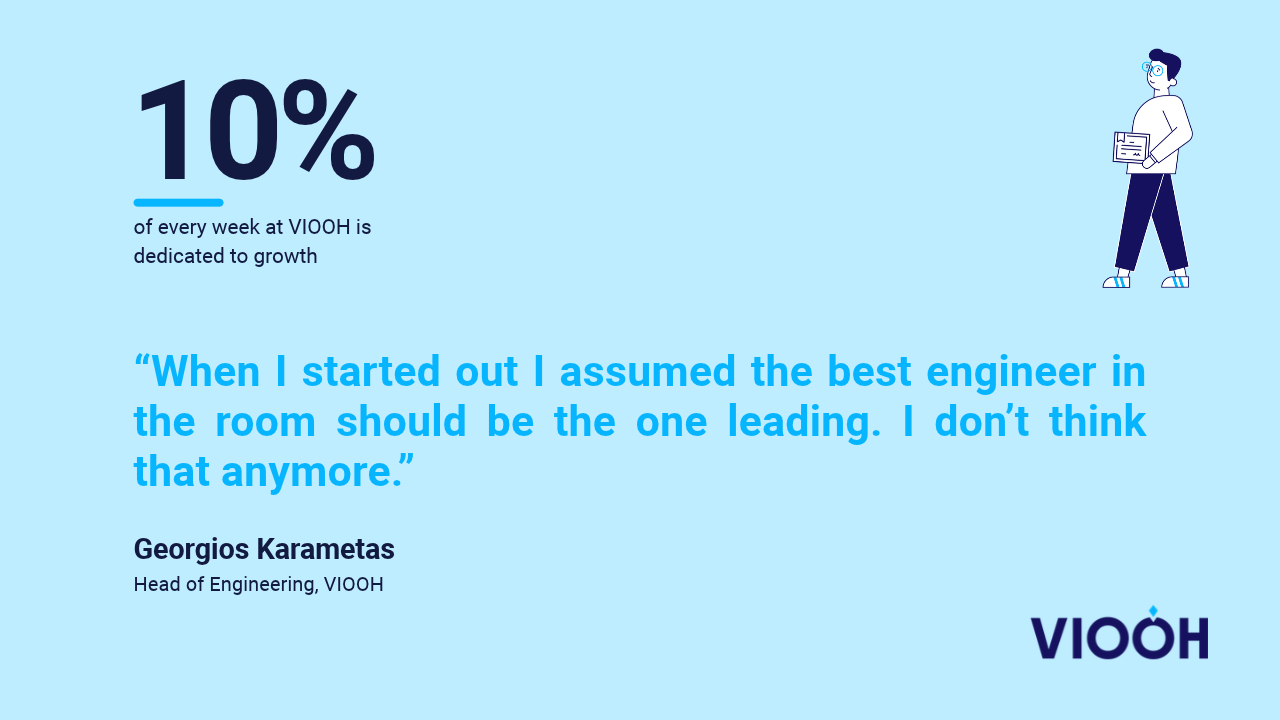
When I started out I assumed the best engineer in the room should be the one leading. I don't think that anymore. You still need the technical side — it's how you earn trust, and how you tell a good plan from a confident one — but most of my hard days as a manager have nothing to do with code. They're about two teams wanting the same thing, or someone on the team having a rough year, or explaining to the business why the boring work is the important work.
So my advice would be: stay close to the craft, and keep a builder's mindset. With AI, that's only going to matter more. The people who will do well are the ones who still want to make things — try stuff, ship small, see what breaks — instead of waiting for a perfect spec. Use AI properly instead of just talking about it. And then the rest: actually listen, understand how the business makes money, and get comfortable saying "I got that wrong" in front of the team. None of that shows up on a tech radar, and all of it shows up in your week.
The Takeaway
Georgios’ journey highlights what our 10% growth pillar is all about: empowering engineers to own their career trajectories, whether that means perfecting specialized technical skills or stepping up to bridge the gap between engineering and business strategy.
When you give talented people the time, resources, and trust to learn, the entire organization benefits from clearer decisions, better collaboration, and stronger leadership.
Interested in joining a culture that prioritises your development?
Explore open roles on the VIOOH Careers Page and see where your 10% could take you.
Other posts you might be interested in
View All PostsSign up to receive our newsletter
Stay in the loop and find out what's happening in the world of digital OOH.