Digital billboards are a "one-to-many" medium, which makes audience calculation completely unique compared to your mobile screen. Adam Collins (Regional Partnerships Director, DSPs) kicks off our new series by breaking down how the industry measures impressions accurately.

Check out his insights below:
"If you work in Out-of-Home (OOH), or have been involved in OOH conversations, you’ll have heard the term “one to many” more times than you can count. If you haven’t, then it’s the single phrase that describes why the OOH industry is like no other, and so fascinating, powerful and challenging in equal measures.
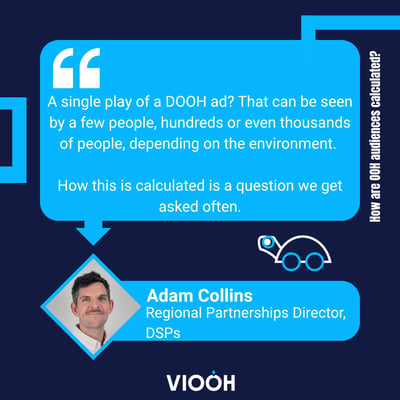
Unlike with personal devices, DOOH viewership is unique. The closest comparison is perhaps TV, with the possibility of multiple people viewing a show or a live sport together on the same screen. A single play of a DOOH ad? That can be seen by a few people, hundreds or even thousands of people, depending on the environment. How this is calculated is a question we get asked often.
The exact answer depends on whether you’re talking about place-based screens (e.g. malls, office buildings and residential) or outdoor screens (e.g. street furniture and billboards) - we’ll talk about these two in more detail in a later episode.
Generally, accurate audience measurement relies on a combination of complex methodologies. These data sets will help build a picture of how people move about on a daily basis, and critically, how they engage with OOH posters and screens as they do so. We can even go a step further than this and not just measure who could possibly see the screen, but calculate the likelihood that someone did. This would take into account the size, height, and angle of the screen, as well as how far a person may be away from this screen. Naturally, factors like time of day, day of week and week of year also matter.
Compiling all of these data points into a coherent picture is a challenge, but luckily, there are solutions that are experts in exactly this. In more developed OOH markets, Joint Industry Committees (JICs) are tasked with producing accurate, independently verified impression data for the largest OOH players. Some examples of these bodies are Route (UK), Geopath (US), OMA (AU) and Mobimetrie (FR). These bodies provide the gold standard currency and allow brands to buy OOH with confidence.
As well as allowing OOH media owners to sell traditionally, this data will also feed into the programmatic bidstream. How exactly? Well, you’ll have to wait for a future post."
👀 Stay tuned! In our next episode of The DL on DOOH, we’ll be uncovering even more of the biggest questions, trends, and tech in the outdoor advertising space. You won't want to miss it...
Follow us on www.linkedin.com/company/viooh